CUTCH

BRIEF HISTORY
The family allied itself and intermarried with the Muslim rulers of Gujerat and Afghanistan, as well as, the Imperial Mughal dynasty of Delhi. These close relations helped to preserve the state during difficult periods of anarchy, gained wealth, influence and titles.
Cutch obtained much of its wealth from its ports and through maritime trade. Cutchi traders were famous in most of the ports of the Indian Ocean. The slave markets in Zanzibar amongst their more unsavoury sources of income.
Maharao Khengarji III became a well-known figure in Europe through his close personal relations with European Royalty. He was a friend of the Queen Victoria during her old age, a relationship that caused some jealousy amongst Civil Servants in India. His reign lasted for a record 67 years, during which the state advanced beyond all recognition.
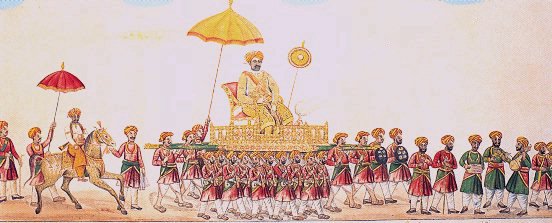
Madan Sinhji belonged to a new breed of Royalty, who placed their education, contacts and skills at the disposal of the new India. He joined the Indian Foreign Service in 1953 and carved out a new career for himself, representing his country in far-flung corners of the globe. Meanwhile, his former state found itself in a vulnerable position, directly on the new border with Pakistan. The Rann of Cutch served as the lamentable arena for fierce armoured battles between the forces of India and Pakistan.
SALUTE:
17-guns.
ARMS:
Quarterly of gules, azure, or and sable, a palm tree proper; in the first quarter over a sword and axe in saltire a banner or; in the second quarter, on a chief azure an eastern gallion argent; in the third, a cow proper; in the fourth, a lion wounded by a lance argent. Helmet:Argent, visor open. Crest: Dexter, a castle, ensigned "Bhuj" on a wreath argent; sinister, an elephant caparisoned by a "howdah"and mounted with a mahout and passengers, between a flag-pole with a swallow-tailed flag or thereon a sun in splendour and crescent argent, above a "Mahi Martib". Supporters: Horsemen mounted proper, dexter armed with a sword, sinister with lance and swallow-tailed flag or thereon a sun in splendour and crescent argent. Motto: "Courage and Confidence". Lambrequins: Gules and argent.
FLAG:
A rectangular red flag with the three crests in white, in the centre.
STYLES & TITLES:
The ruling prince: Maharajadhiraj Mirza Maharao Shri (personal reign name) Sawai Bahadur, Maharao of Cutch, with the style of His Highness.
The consort of the ruling prince: Maharani Shri (personal name) Sahib, with the style of Her Highness.
The Heir Apparent: Maharajkumar Shri (personal name) (father's name), Yuvraj Sahib of cutch.
The younger sons, grandsons and great-grandsons of the ruling prince, in the male line, during his lifetime: Maharajkumar Shri (personal name) (father's name) Sahib.
The younger brothers of the ruling prince, after the death of their father: Maharaj Shri (personal name) (father's name) Sahib.
The daughters, granddaughters and great-granddaughters of the ruling prince, in the male line: Maharajkumari Bai Shri (personal name) Sahib.
The consort of a Maharaj or Maharajkumar: Rani Shri (personal name) Sahib.
The sons of a Maharaj, during his lifetime: Maharajkumar Shri (personal name) (father's name) Jadeja.
The daughters of a Maharaj: Maharajkumari Bai Shri (personal name) Sahib.
The other male members of the family, descended in the male line: Kumar Shri (personal name) (father's name) Sahib.
The other female members of the family, descended in the male line: Kunverji Bai Shri (personal name) Sahib.
ORDERS & DECORATIONS:
None known.
RULES OF SUCCESSION:
Male primogeniture, with the right of adoption by the recognised head of the family, on the failure of natural heirs.
SOURCES:
Gazetteer of the Bombay Presidency. Volume VIII. Kathiawar. Government of Bombay, Bombay, 1884.
Ann Morrow, Highness, The Maharajas of India, F.A. Thorpe (Publishing) Ltd, Anstey, Leicestershire, first published by Grafton Books, London 1986, first Charnwood ed. published Nov.1987
The Rajkumar College Alumni Website. http://www.rkcians.com/index.php
T. S. Randhawa, Kachchh, The Last Frontier. Prakash Books, New Delhi, 1998.
The Ruling Princes, Chiefs and Leading Personages in the Western India States Agency, 1st edition. Rajkot, 1928.
The Ruling Princes, Chiefs and Leading Personages in the Western India States Agency, 2nd edition. Manager of Publications, Delhi, 1935.
Capt. H. Wilberforce-Bell, The History of Kathiawad, from the earliest times. William Heinemann, London, 1916.
SPECIAL ACKNOWLEDGEMENTS:
Maharajkumari Narendra Kumari of Kutch.
Vijayeta Kumari.
Steve Ruelberg.
Copyright©Christopher Buyers, December 2001 - May 2024